Wednesday, April 8, 2020

From NC wall boards to feed trough

The weather has been quite decent the last few weeks. The snow has mostly melted and we are under orders to "Stay Home, Stay Safe." To the homesteader, life goes on as it always does. I just can't go buy toilet paper when I want.

The goats and the chickens (and all the other resident mouths-that-that-need-feeding), haven't realized the world has currently gone loopy. They don't need toilet paper, however, they do need other things and two of the ladies are due to give birth any day now.

Ahem. This is not a post about them. This is a post about a feeding trough.

As I was prepping the birthing pen, I decided to move the home-made hay hopper from the girl pen to the birthing pen. Since I was also using the hopper as a feed trough, I have to fabricate the girls a new feeder.


Digging through the second floor of the barn, I found some tongue and groove wall boards that I took down when remodeling our house in North Carolina, which I transported up north during the move. Exactly why I saved them, this is a perfect use for it.

I quickly saw it in half and edge nail it together.


This bit is a cut off from the flooring in our current house, which was also found on the second floor of the barn. Seems to fit just about right. 


I saw it in half...


and nail it to the ends of the wall boards. 


This was so easy I'm embarrassed to blog about it. 

Here it is below the new hay hopper. 


I didn't like it there so I moved it to the other corner. Elizabeth Collins gives it a looking over. 


There is no problem with getting them to use it. 

The two ladies on the far end are Victoria Winters and Franny, our expecting mothers. Elizabeth has gone from looking at the trough, to standing in the trough. She was planning her attack when all the seating is taken. 

My wife really liked this trough and wants one for the buck/wether's pen. Those guys are currently eating off the floor and honestly don't seem to mind. 

Dan.


Monday, April 6, 2020

Quick cabinet hinge repair


Hey, what the heck is going on here?


Oh, I see. I've been using the cooling rack lately and it wedged behind that hinge, forcing the hinge apart when I closed the cabinet. 


It's just a simple screw holding the two pieces of the hinge together, not broken. 


Just a simple matter of loosening the screw, returning the door side of the hinge to it's proper location, and retightening the screw. 


Ok, so I had to take it back apart to adjust it. There are little ridges where the two halves of the hinge meet. I had to shift the door side out about 1/4-inch. 


That's better! At least it was an easy fix. 

Dan.


Friday, April 3, 2020

Rock Buh-bye glue joint

Chairs are one of the most abused furniture pieces in your household. Constant strain is placed on the joinery and glues can breakdown and fail over time. It doesn't help when large companies mass-produce chairs and starve the joinery in order to save a few pennies per chair.  

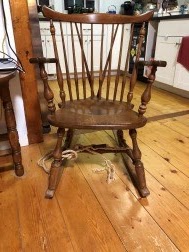
As an example, I have a rocking chair that dates to the 1970's. It's not fancy but I like it, it's "my" chair. Naturally, my 200 pound frame will test the joinery to it's limits and it's a good example of a glue-starved joint. 

Taking it to the chair to the shop, I test all the joinery and glue-up the ones that have failed. 

I personally only use hide glue on my indoor projects. I like the ability of it sticking to itself in later repairs, the fact it is non-toxic, and easy clean-up with water. 


To hold the joint closed to allow the glue to set, I grab a length rope kept in the shop for this reason. Add a small peg made from a length of pine I shaped on the shaving horse and you have a home-made tourniquet clamp. This is an old-timey method that is unbeatable for clamping odd shapes and rounds. 

The technique is simple; twist the rope as much as you can pinning the peg so that the rope remains taut while the glue dries. 


I normally allow at least 24 hours when using hide glue. 


Of course, after finishing one repair, I had another location that needed a glue up. 

If this was a piece I had to repair for a customer, I would had given all the joints a solid whacking with a rubber mallet the first time to ensure everything was good before returning it to them. Not something I always do for myself. 


When all is finished, the chair goes back to it's spot in the common room, ready for more Dan rocking. 

Dan.